On this page
Bathrooms are the most expensive rooms per square foot in a house. A 40-square-foot bathroom needs demo, framing, plumbing, electrical, waterproofing, tile, drywall, paint, ventilation, fixtures, and two or three inspections, which is the same trade list a 400-square-foot basement needs. That is why a bath costs $120-$275 per square foot while a basement costs $30-$75. Below are the real 2026 numbers, split by bathroom type and then by line item, so you can see which of your decisions is actually moving the total.
Two numbers do most of the explaining. The first is that labor is 40-60% of a bathroom, higher than almost any other remodel, because the work is slow, awkward, and sequential: one trade at a time in a room the size of a closet. The second is that moving a fixture costs $1,500-$4,000 per fixture on top of everything else. Keep the plumbing where it is and you stay near the bottom of every range on this page. Move the toilet across the room and you have quietly added the price of a new vanity and tile package.
2026 Cost by Bathroom Type
| Bathroom type | Typical size | Budget | Mid-range | High end |
|---|---|---|---|---|
| Half bath (powder room) | 15-25 sq ft | $5,000-$7,500 | $7,500-$11,000 | $11,000-$15,000+ |
| Small full bath (5x8 hall) | 35-45 sq ft | $12,000-$18,000 | $18,000-$24,000 | $24,000-$30,000+ |
| Guest or kids bath | 45-70 sq ft | $15,000-$22,000 | $22,000-$32,000 | $32,000-$45,000+ |
| Primary bath | 100+ sq ft | $30,000-$42,000 | $42,000-$58,000 | $58,000-$75,000+ |
| Tub to shower conversion | existing footprint | $6,000-$9,000 | $9,000-$12,000 | $12,000-$15,000+ |
| Cosmetic refresh (no layout change) | any | $4,000-$7,000 | $7,000-$10,000 | $10,000-$14,000+ |
2026 US national ranges for professional work, materials and labor, permits included. Chicago-area and coastal metros run at or above the high end.
The half bath is the useful reference point. It has no shower, no tub, and no waterproofing, and it is still $5,000 at the absolute bottom, because you are still paying for demo, a toilet, a vanity, a light, an exhaust fan, floor tile, paint, and a permit. Everything above a half bath is that baseline plus a wet area. The wet area is the whole game.
The tub to shower conversion deserves its own row because it is the most requested single change we get, and its price depends almost entirely on one question: does the drain move? A tub drain sits in a different spot than a shower drain, so a straight swap usually means opening the floor and reworking the trap. That is why the range starts at $6,000 rather than the cost of the shower alone.
Line Item Breakdown: 5x8 Full Bath, Mid-Range
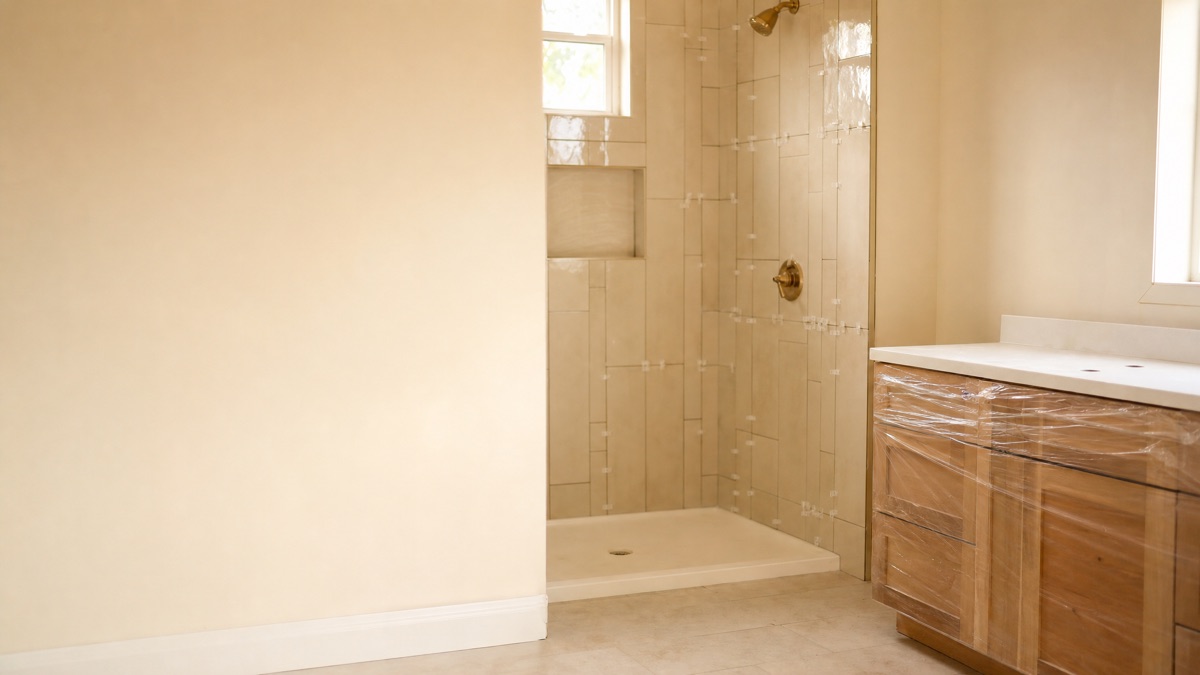
Here is where the money actually goes on the most common job in America: a 40-square-foot hall bath, gutted to the studs, rebuilt in the same layout, mid-range finishes, tiled shower over the existing tub footprint.
| Line item | Typical range | Notes |
|---|---|---|
| Demo and disposal | $1,000-$3,000 | Tear to studs and subfloor, dumpster, haul-off |
| Plumbing | $2,000-$8,000 | Rough and trim in place; add $1,500-$4,000 per fixture moved |
| Electrical | $1,000-$3,500 | GFCI, dedicated circuits, vanity and can lights, fan wiring |
| Framing and subfloor repair | $500-$2,500 | Blocking for grab bars, rot repair if found |
| Waterproofing and shower pan | $800-$2,500 | Membrane, pan, corners, seams, curb |
| Tile labor | $10-$25 / sq ft | Roughly $1,500-$3,500 on a typical floor plus shower walls |
| Tile material | $3-$25 / sq ft | Ceramic at the bottom, porcelain mid, natural stone at the top |
| Shower unit | $1,500-$15,000 | Prefab base and surround $1,500-$4,000; custom tile $5,000-$15,000 |
| Shower glass | $700-$3,500 | Sliding door low, frameless panel high |
| Vanity and top | $500-$4,000 | Stock 30 in. at the bottom, custom double at the top |
| Toilet, installed | $250-$900 | Standard two-piece to comfort-height one-piece |
| Ventilation fan | $250-$700 | Includes ducting to the exterior, not the attic |
| Drywall, paint, trim | $800-$2,200 | Cement board in the wet area, greenboard elsewhere |
| Permits and inspections | $300-$1,000 | Plumbing and electrical typically inspected separately |
Add 10-15% contingency on any gut job. Something behind the wall is always different from what the plans assumed.
Add the middle of those ranges and you land right where the type table says you should: about $19,000 to $22,000 for a mid-range 5x8. If you are pricing your own tile package, run the square footage through the tile calculator first, and read how much extra tile to buy before you order, because a mid-job reorder on a discontinued lot is the cheapest expensive mistake in this trade.
What Drives Cost Up
- Moving plumbing. $1,500-$4,000 per fixture relocated. Swapping the toilet and vanity positions on a slab or over a finished ceiling can add $5,000 by itself. If the layout works, leave it.
- Custom tile showers. A prefab base and surround is one day and $1,500-$4,000. A tiled shower is waterproofing, mud bed or foam pan, layout, cuts, cure time, and grout, at $5,000-$15,000. It looks better and lasts longer, and it costs three to four times as much.
- Niches and benches. Every niche is framing, membrane, corner detailing, and a lot of small cuts: $300-$800 each. A built-in bench is $500-$1,500. They are worth it, but they are not free, and quoting three niches is quoting a fourth of a vanity.
- Heated floors. Electric mat systems run $12-$25 per square foot installed plus a dedicated circuit and a $150-$300 thermostat. On a 40-square-foot bath that is roughly $800-$1,400 all in.
- Glass. Frameless glass is $1,200-$3,500 for a typical enclosure and cannot be ordered until the tile is set and measured, so it also drives the schedule.
- Subfloor rot. The most common surprise. A leaking toilet flange or a failed shower pan quietly feeds the subfloor for years. Discovery at demo adds $500-$3,000, more if joists are involved.
- Cast iron drain replacement. In pre-1970s houses the drain stack is often cast iron at the end of its life. Replacing the section serving the bath runs $1,500-$5,000, and it is not optional once it is cracked and open in front of an inspector.
Two of those, the subfloor and the drain stack, are the reason we quote a contingency instead of a flat number on older homes. Nobody can see through a floor. The honest version is a firm price on known scope plus a written unit price for the things that only show up after demo day.
Where to Save, and Where to Never Skimp
Real savings, in the order they are worth chasing:
- Keep the layout. The single largest lever on this page. Same toilet spot, same vanity wall, same shower drain saves $3,000-$8,000 on a full bath.
- Porcelain that looks like stone. Large-format porcelain at $4-$8 per square foot reads like marble at $18-$30, and does not need sealing.
- Tile the wet area, paint the rest. Floor-to-ceiling tile on all four walls is a finish choice, not a waterproofing requirement.
- Stock vanity, upgraded top. A $600 stock cabinet with a $400 quartz top reads far better than the price suggests.
- Do the demo, the paint, and the accessories yourself. Genuinely $1,500-$3,500 of labor on a full bath, and none of it is inspected.
Never skimp on waterproofing
Waterproofing is $800-$2,500 of a $20,000 bathroom, roughly 5-10% of the job, and it is the only line item whose failure destroys everything installed on top of it. A shower that leaks behind the tile does not announce itself. It shows up two or three years later as a soft floor, a stained ceiling below, or mold in a wall cavity, and the fix is a full re-tear of the shower at $6,000-$12,000.
What that means in practice: a continuous bonded membrane system on the walls and pan, pre-formed corners, seams treated per the manufacturer, a proper sloped pan, and a flood test before a single tile goes on. Cement board alone is not waterproofing. Neither is a rolled coating applied over unsealed seams. Ask any bidder which membrane system they use and whether they flood test. If the answer is vague, that is your answer.
The same logic applies to the two other things worth paying full price for: the exhaust fan and the electrical. A properly sized fan ducted to the outside, not into the attic, is $250-$700 and it is what keeps the paint, the grout, and the drywall alive. GFCI protection and correct circuits are $1,000-$3,500 and they are what the inspector is actually there for.
On DIY specifically: the realistic ceiling is 25-40% off the total, not the 60% people expect, because labor is 40-60% of the job and roughly half of that labor is work you should not do. DIY bathrooms fail in three predictable places. Waterproofing, covered above. Drain and vent work, where a wrong slope or a missing vent produces a slow drain and a sewer smell that no amount of tile fixes. And inspections, where uninspected plumbing and electrical become a disclosure problem the day you sell.
What You Get Back at Resale
A mid-range bathroom remodel recoups roughly 60-70% of its cost at resale in 2026, and upscale primary suites recoup less as a percentage, generally in the 50-60% band. That pattern holds across every remodeling cost-versus-value survey, and the reason is simple: buyers price a bathroom as functional or dated, not as a dollar figure.
Which means the return case is strongest exactly where the spend is smallest. Bringing a failing, 1970s-tile, avocado-fixture bathroom up to clean and current returns more per dollar than turning a perfectly good bathroom into a spa. If you are remodeling to sell within a year or two, stay mid-range and keep the layout. If you are staying ten years, buy the shower you want, because the daily use is the actual return.
How Long a Bathroom Remodel Takes
Budget three to five weeks of active work for a full bath and four to seven for a primary suite, with the caveat that the bathroom is unusable for most of it. The schedule is set by two things that cannot be rushed: inspections between rough and cover, and cure times on the shower pan, the thinset, and the grout. Rushing either of those is how a bathroom ends up needing the re-tear described above.
The full day-by-day sequence, including where delays actually come from and how to plan around one bathroom being offline, is in our bathroom remodel timeline. If the bath is part of a larger project, the whole home renovation timeline covers how to phase it so you are never without a working bathroom.
Frequently Asked Questions
How much does a bathroom remodel cost in 2026?
Nationally, a full gut and rebuild runs $120-$275 per square foot in 2026. That puts a standard 5x8 hall bath at $12,000-$30,000, a half bath at $5,000-$15,000, and a primary bathroom of 100 square feet or more at $30,000-$75,000 and up. The spread inside each range comes down to whether plumbing moves and whether the shower is prefab or custom tile.
How much does a small bathroom remodel cost?
A small full bath (roughly 35-45 square feet, the classic 5x8 with tub, toilet, and single vanity) costs $12,000-$30,000 gutted and rebuilt in place. A cosmetic refresh that keeps the tub and the layout, swapping vanity, toilet, fixtures, lighting, and floor tile, lands closer to $6,000-$12,000. Small does not mean cheap per square foot, because a bathroom of any size still needs every trade.
How much does a master bathroom remodel cost in 2026?
Primary bathrooms of 100 square feet or more run $30,000-$75,000 in 2026, and suites with a freestanding tub, a curbless custom-tile shower with glass, double vanities, and heated floors regularly pass $90,000. The single biggest swing is the shower: a prefab base and surround is $1,500-$4,000 while a custom tiled shower with a bench, a niche, and frameless glass is $5,000-$15,000 before the glass.
How much can I save remodeling a bathroom myself?
Realistically 25-40% of the total, because labor is 40-60% of the job and you cannot legally or safely do all of it. Demo, painting, vanity and toilet setting, trim, and accessories are genuine DIY savings worth a few thousand dollars. Shower waterproofing, drain and vent work, and anything the inspector signs off on are where DIY bathrooms fail and get redone.
Does a bathroom remodel add value to a home?
A mid-range bathroom remodel typically recoups 60-70% of its cost at resale, and a high-end primary suite recoups less on a percentage basis. The better argument is usually condition rather than return: a dated or leaking bathroom is one of the first things buyers price against you, and a sound, current bathroom removes that objection.
Pricing a Bathroom Remodel in Joliet or Will County?
Rehab Addicts remodels bathrooms across Joliet, Shorewood, and Will County, IL, from powder rooms to full primary suites, with bonded waterproofing, flood-tested pans, and permits and inspections handled. See our bathroom remodeling service for what a job with us looks like. Free estimates, itemized so you can see every line above.