On this page
Cabinets are the single biggest line item in almost every kitchen remodel, usually 30-40% of the total budget, and the one where the same kitchen can honestly cost $4,000 or $40,000. The difference is not magic. It is box material, door style, how many drawers you asked for, and whether a factory or a cabinetmaker built them. Here is what cabinets actually cost in 2026 and how to tell which tier your kitchen needs.
Kitchen Cabinet Cost at a Glance
Cabinets are priced per linear foot of wall run, and the industry benchmark is the "10x10 kitchen," an L-shaped layout on two 10 foot walls that works out to roughly 20-25 linear feet once you account for a normal mix of base and wall cabinets. Nobody actually has a 10x10 kitchen. It is a yardstick for comparing quotes, and it is the number every catalog and showroom uses, so we use it here too.
2026 Cost by Cabinet Type
| Cabinet type | Per linear foot | 10x10 kitchen (20-25 LF) | What you get |
|---|---|---|---|
| Stock | $100-$300 | $3,000-$7,000 | Fixed sizes in 3 in steps, particleboard boxes, 4-8 door styles, ships in 1-3 weeks |
| Semi-custom | $200-$650 | $6,000-$15,000 | Factory sizes plus modifications: plywood boxes, any door and finish, drawer stacks, reduced depths |
| Custom | $500-$1,500+ | $15,000-$35,000+ | Built to the room, any species or size, inset doors, integrated appliance panels, furniture details |
| IKEA (boxes plus fronts) | $120-$300 | $2,500-$7,000 before install | Frameless boxes, soft-close hardware standard, flat packed, assembly is on you or your installer |
| Installation labor only | $50-$150 | $2,000-$6,000 | Set, shim, scribe, level, hang, hardware, crown and filler work |
Installed columns include labor. Old cabinet demo and haul-away adds $300-$800. Countertops, backsplash, and appliances are separate.
Stock cabinets come off a shelf or out of a regional warehouse in fixed widths, usually 9 to 42 inches in 3 inch increments. Boxes are almost always particleboard with a laminate interior, the door list is short, and finishes are limited to whatever the line runs. They are not junk. A stock cabinet with a plywood side upgrade and decent hardware will outlive most owners' interest in the kitchen. The trade-off is that your layout has to bend to the sizes available, which usually means filler strips at the ends of runs.
Semi-custom is the same factory, same production line, more options. You pick the door style, the finish, the box material, and then order modifications: a 33 inch cabinet reduced to 31 and a half, a base cabinet turned into a three drawer stack, a 15 inch deep upper over the fridge, a pantry with roll-out trays. Lead times stretch to 6-10 weeks because the order is built after you sign it. This is where most kitchens we build land, because it gets you the look of custom in a room with normal dimensions.
Custom means a shop builds to your drawings. Any size to the sixteenth of an inch, any wood species, inset doors, integrated panels that hide the dishwasher and fridge, hand applied finishes. You go here for a room with odd angles, low windows, an 11 foot ceiling that wants cabinets to the top, or a specific look nobody catalogs. Expect $500-$1,500 per linear foot and 10-16 weeks.
IKEA sits in its own lane. The frameless boxes are melamine over particleboard, the hardware is genuinely good (soft-close is standard, not an upcharge), and the boxes hang on a rail system that makes leveling forgiving. The catch is assembly: every box is flat packed, and that labor is why independent installers quote $3,000-$6,000 for a kitchen. Add third party doors and you have paid semi-custom money for a particleboard box.
What Actually Drives Cabinet Cost
Within any tier, the quote moves for six reasons. Ask a showroom to reprice your kitchen with these changed and you will see the same swings.
| Upgrade | Typical adder | Our take |
|---|---|---|
| Plywood boxes instead of particleboard | +10-20% of cabinet cost | Worth it, at minimum under the sink and beside the dishwasher |
| Inset doors instead of full overlay | +20-30% | Pure looks, and it costs you a little interior space |
| Painted finish instead of stained | +10-15% | More steps in the factory, and touch-ups later are harder to match |
| Drawer bank instead of a door with a shelf | +$100-$250 per base cabinet | The single best money in the kitchen |
| Soft-close hinges and undermount glides | +$5-$15 per door or drawer | Standard on most lines now, confirm it is not an add |
| Tall pantry unit (84-96 in) | $400-$1,200 stock, $900-$2,500 semi-custom | Two stacked wall cabinets can do the same job for less |
| Crown molding, light rail, fillers, panels | $300-$1,200 per kitchen | Not optional if you want the run to look finished |
| Glass doors, interior lighting, glass shelving | $150-$400 per door | Skip on a budget, it is the first thing to cut |
Adders are on top of the base cabinet price for the tier you chose, and the labor to install them is usually already in the per linear foot number.
- The box. Particleboard is fine dry and terrible wet. One dishwasher leak swells a particleboard base cabinet floor permanently. Plywood costs 10-20% more across the kitchen and is the upgrade we push hardest.
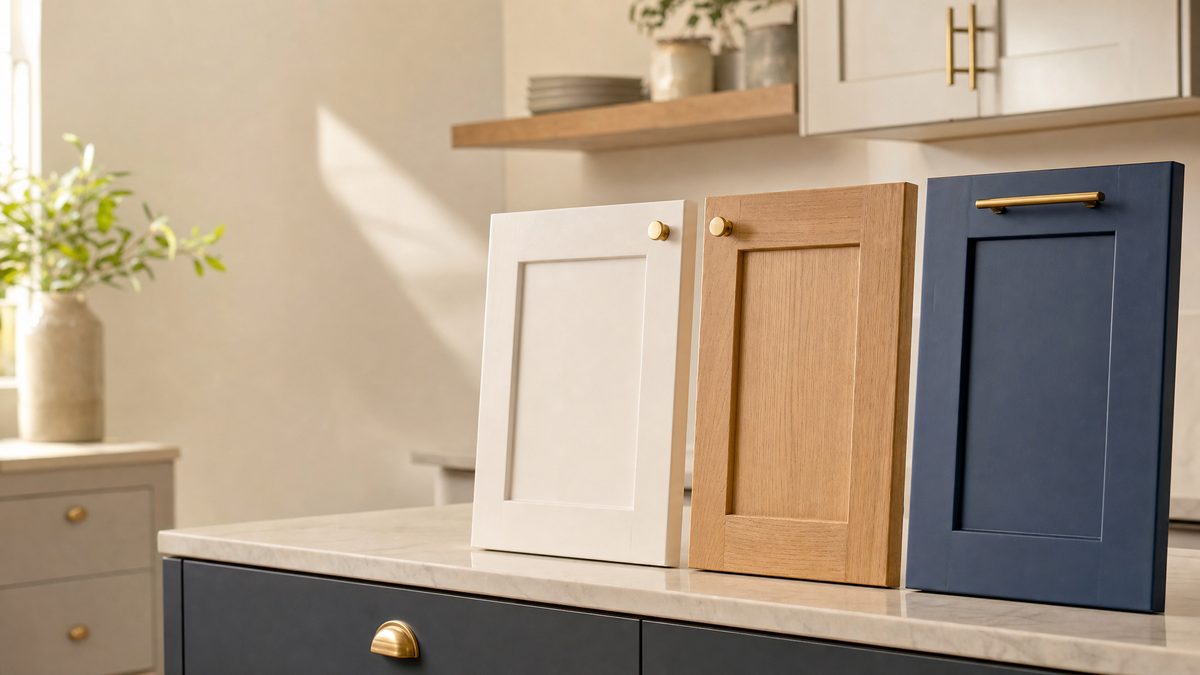
- The door. Slab is cheapest, shaker is the volume seller and barely costs more, raised panel sits above that, and inset (the door sits flush inside the frame rather than over it) runs 20-30% more because the tolerances are tighter and every hinge has to be dialed in.
- The finish. Thermofoil is a vinyl skin over MDF, cheap and seamless until it peels near a heat source. Stained wood shows grain and hides wear. Painted is the most expensive and the most popular, and it telegraphs every joint movement in the door over time.
- Drawers versus doors. A three drawer base costs $100-$250 more than a door base with one shelf. Ten drawers instead of ten doors is a $1,000-$2,500 swing, and it is the difference between a kitchen you like and a kitchen you crawl into.
- Tall units and specialty cabinets. Pantries, appliance garages, corner lazy susans, trash pull-outs, and spice racks all price well above a plain base of the same width.
- Trim and fillers. Crown, light rail, scribe molding, toe kick, and finished end panels are line items, not freebies. On a stock job they are what makes it stop looking like stock.
Replace, Reface, or Paint
Before you price new cabinets, price not buying them. If the boxes are solid and the layout works, two cheaper paths get you most of the visual change.
| Option | 2026 cost | Lifespan | When it makes sense |
|---|---|---|---|
| Full replacement | $3,000-$35,000+ | 20-30 years | Boxes are damaged or swollen, layout is changing, or you want different sizes and drawer configurations |
| Refacing | $4,000-$12,000 | 10-20 years | Boxes are square and solid, layout stays, you want a new door style and finish |
| Professional repaint | $2,000-$6,000 | 5-10 years | Doors are in good shape and the style is fine, you just want a different color |
| Hardware and glide retrofit only | $300-$900 | 10+ years | Everything works, drawers sag or slam, budget is tight |
Refacing means new doors and drawer fronts, new hinges, and matching veneer or laminate on every exposed box face. Painting the boxes and reusing the doors is a different, cheaper job.
Refacing sounds like a shortcut and it is a real one, but the math flips fast. Once you are past $10,000, you are inside stock replacement territory with 30 year old boxes still bolted to the wall. Reface when the carcasses are plywood and true. Replace when they are particleboard, when the sink base has ever gotten wet, or when you want to move anything.
A repaint is the cheapest honest refresh, and it is the one homeowners most often try themselves and regret. Cabinet paint has to be degreased, sanded, primed with a bonding primer, and sprayed, not rolled, or it stays tacky and chips at every fingernail. If you are going to do it yourself anyway, our paint calculator sizes the material.
How to Count Your Linear Feet
Every quote you get will be built on this number, so measure it once yourself and you will never be surprised by a bid. Linear feet means feet of wall run that carries cabinets, measured along the wall, not the perimeter of the room and not square footage.
Here is a real L-shaped kitchen with an island, worked all the way through.
- Wall A: 13 feet, sink wall, with a 3 foot window over the sink.
- Wall B: 10 feet, range wall, with a 30 inch slide-in range.
- Island: 6 feet long, cabinets on one side only.
Start with base cabinets. Wall A plus Wall B is 23 feet of run. The two walls meet in a corner, and a base cabinet is 24 inches deep, so 2 feet of that run is the same corner counted twice. Subtract it: 21 feet. Now subtract the 30 inch range opening, which is 2.5 feet: 18.5 feet of base cabinets. Add the 6 foot island: 24.5 linear feet of base, call it 25.
Uppers are counted separately when a shop itemizes, but per linear foot pricing already assumes a normal ratio of wall cabinets to base. Sanity check it anyway. Over the same 21 feet of wall run you lose 3 feet to the window and 2.5 feet to the hood, leaving about 15.5 feet of uppers. That is a slightly upper-light kitchen, which means a per linear foot quote is, if anything, a hair generous. If your kitchen has a wall of uppers to the ceiling and few base cabinets, the ratio runs the other way and the catalog number will come in low.
At 25 linear feet, 2026 pricing puts this kitchen at roughly $2,500-$7,500 in stock, $5,000-$16,250 in semi-custom, and $12,500-$37,500 custom, installed. Once the boxes are set, the countertop template follows the same run, and our countertop calculator turns those same measurements into square feet of slab.
Order cabinets before you demo, not after
Stock ships in 1-3 weeks. Semi-custom is 6-10 weeks from the day the order is signed off, and custom is 10-16 weeks. Those clocks start at final approval, not at the showroom visit, and a single change to a door style or finish restarts them. The most common reason a kitchen sits gutted for two months is that demo happened before the cabinets were ordered.
Our rule: sign the cabinet order, confirm the ship date in writing, then schedule demo to land about a week before delivery. The full sequence is in our kitchen remodel timeline.
Where to Save, and Where Not to Skimp
Save here without regret
- Keep the layout. Moving a sink or a range means plumbing, electrical, and sometimes venting, and it can add $2,000-$6,000 before a single cabinet arrives. Cabinets in the same spots as the old ones is the cheapest good kitchen there is.
- Stock boxes, upgraded doors and hardware. Nobody opens your cabinet to inspect the side panel. Put the money into the doors, the pulls, and the drawer glides.
- Two stacked wall cabinets instead of a tall pantry. Same storage, often $300-$800 less, and it breaks up a wall better anyway.
- Skip glass doors, interior lights, and open shelving units. They are $150-$400 per door and the first thing that stops feeling special.
- Paint the island a different color rather than ordering it as a custom furniture piece. It reads as designed and costs a gallon of paint.
- Reface if the boxes are genuinely good. Pull a drawer out and look at the box floor. Square, dry, plywood, no sag means reface is on the table.
Do not skimp here
- Plywood under the sink and next to the dishwasher. Those two cabinets take every leak in the kitchen. Particleboard swells and never comes back. If your budget only buys plywood in two spots, buy it in these.
- Full-extension undermount soft-close glides. Side-mount epoxy glides sag under a loaded drawer within a few years and only open two thirds of the way. This upgrade is $5-$15 per drawer and you feel it every single day.
- Dovetailed plywood drawer boxes. Stapled particleboard drawer boxes are where cheap cabinets fail first, usually in the silverware drawer.
- Six-way adjustable hinges. They are what lets an installer bring every door face into the same plane. Cheap hinges cannot be dialed in, and crooked doors make good cabinets look bad.
- Installation. Houses are not level or square. A good installer shims, scribes filler strips to the wall, and ties runs together so the faces line up. Paying $50 per linear foot for a fast install of $600 per foot cabinets is a bad trade.
Frequently Asked Questions
How much do new kitchen cabinets cost in 2026?
A typical 10x10 kitchen of about 20-25 linear feet runs $3,000-$7,000 in stock cabinets installed, $6,000-$15,000 semi-custom, and $15,000-$35,000 or more custom. Per linear foot installed, that is $100-$300 stock, $200-$650 semi-custom, and $500-$1,500+ custom. Most remodels we do land in the semi-custom band because it buys real door and box choices without a cabinet shop's price tag.
How much are kitchen cabinets per linear foot?
Installed, 2026 pricing is $100-$300 per linear foot for stock, $200-$650 for semi-custom, and $500-$1,500+ for custom. Those numbers assume a normal mix of base and wall cabinets over the same run, which is how suppliers quote. Installation labor alone is $50-$150 per linear foot, or $2,000-$6,000 for a whole kitchen.
Is cabinet refacing cheaper than replacing cabinets?
Yes, usually by half. Refacing runs $4,000-$12,000 because you keep the boxes and buy new doors, drawer fronts, hinges, and matching veneer for the exposed sides. It only pencils out when the boxes are square, solid, and laid out the way you want, since refacing cannot move a sink, widen a cabinet, or fix a swollen particleboard base.
How much do semi-custom cabinets cost compared to custom?
Semi-custom runs $200-$650 per linear foot installed against $500-$1,500+ for custom, so a typical kitchen is $6,000-$15,000 versus $15,000-$35,000 or more. Semi-custom lines are factory sizes with a long modification list: door style, finish, plywood boxes, drawer stacks, reduced depths, and widths in 3 inch steps. You go custom when the room has odd dimensions, you want inset doors and integrated appliance panels, or you need a run sized to the inch.
How much does an IKEA kitchen cost installed?
Boxes, fronts, and hardware for a typical kitchen come to $2,500-$7,000, and independent installers charge $3,000-$6,000 because IKEA cabinets ship flat and have to be assembled before they hang. Budget $6,000-$13,000 all in, before countertops. Swapping in third-party doors from a semi-custom front maker can add $2,000-$5,000 and pushes the total into semi-custom territory anyway.
Pricing New Cabinets in Joliet or Will County?
Rehab Addicts installs stock, semi-custom, and custom cabinets across Joliet, Shorewood, and Will County, IL, and we will measure your linear feet and price all three tiers side by side before you commit. See our kitchen remodeling service. Free estimates.