On this page
Countertops are the one kitchen line item where a two-inch measuring mistake costs real money, because you are buying stone by the square foot and the fabricator prices from the template, not from your sketch. The calculator below turns cabinet runs and an island into square footage, slab count, and an installed price range for eight common materials at 2026 rates. Everything under it explains where those numbers come from so you can read a quote line by line instead of taking the total on faith.
Countertop Calculator
Measure every straight run separately, in inches. Standard base cabinet depth with a 1.5 inch overhang is 25.5 inches.
47.6 sq ft of countertop, 31.7 linear feet of finished edge. Slab count assumes a standard 55 x 120 inch slab, about 46 sq ft gross and roughly 40 sq ft usable after 5-10% fabrication waste and cut layout. Fabricators template the actual cabinets before cutting, so treat this as a budget number, not a purchase order.
How to Measure Countertops (Do It in Inches)
Work in inches and convert at the end. Feet-and-inches arithmetic is where most homeowner estimates go sideways, and stone is cut to a sixteenth. Sketch the kitchen from above, break it into rectangles, and label every run.
- Depth is 25.5 inches on a standard run. Base cabinets are 24 inches deep, the box sits about a half inch off the wall once you allow for out-of-plumb drywall, and the countertop hangs over the door fronts by 1.5 inches. That is the number to use unless you have measured otherwise.
- Measure wall to wall, not cabinet to cabinet. On a run that dead-ends into walls at both ends, the top gets scribed to the wall, so the length is the full wall dimension. Measure at counter height, not at the floor, and measure at both the front and the back of the run because old houses are rarely square.
- Count corners once. Where two runs meet in an L, the corner square belongs to one run only. Run the long leg full length and start the short leg where the long one stops, or you will pay for the same 4 square feet twice.
- Islands get a bigger overhang. Sides with no seating get the same 1.5 inches. Any side people sit at needs 12 inches of unsupported overhang for knee room, or 15 inches if you want it comfortable. Quartz and granite need brackets or steel plates past about 10 inches of overhang, and nobody should be leaning on an unsupported 15 inch cantilever.
- Backsplash is separate. A 4 inch matching stone splash adds roughly a third of a square foot per linear foot of run and gets cut from the same slab. Full-height tile is a different trade entirely, and our tile calculator sizes that.
Your number is a budget number, not the invoice
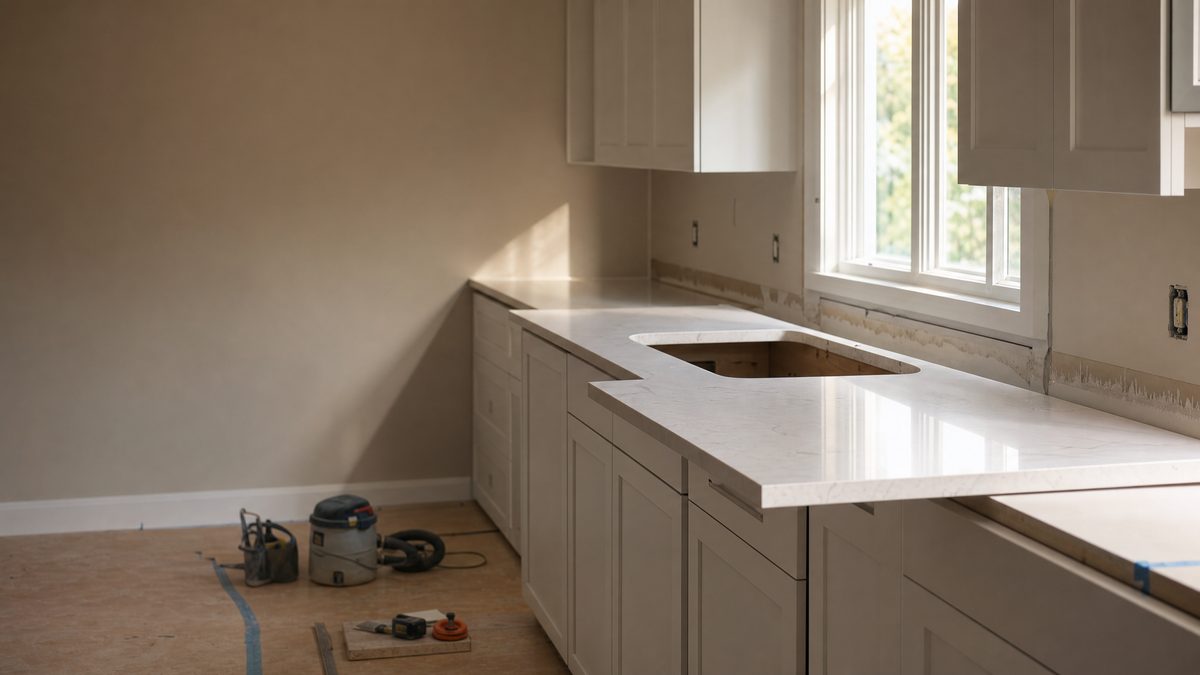
Fabricators do not cut from homeowner measurements. After the cabinets are set and level, a templater comes out with a laser or a set of digital sticks and builds an exact pattern of the space, including the wall waves nobody wants to admit to. The templated area is what you get billed for, and it usually lands within a square foot or two of a careful tape measurement. Templating is why countertops arrive 1-3 weeks after cabinets in almost every kitchen schedule, a gap we cover in the kitchen remodel timeline.
The Math Behind It
Square feet = (length in inches × depth in inches) ÷ 144, summed across every run plus the island. A 96 inch run at 25.5 inches deep is 2,448 square inches, or 17.0 square feet. Add a 60 inch run at the same depth (10.6 sq ft) and a 72 by 40 inch island (20.0 sq ft) and you are at 47.6 square feet, a textbook mid-size kitchen.
Finished edge in linear feet is the exposed front edge of each run plus the full perimeter of the island, divided by 12. That is the number a premium edge upcharge multiplies against, so an island quietly doubles the edge upgrade cost relative to its square footage. In the example above, 156 inches of run front plus 224 inches of island perimeter is 31.7 linear feet.
Slab count is where the arithmetic gets non-linear. A standard quartz slab is about 55 by 120 inches, which is 45.8 square feet on paper. You never get all of it. Cut layout leaves offcuts too narrow to use, the fabricator loses material to the saw and to book-matching veins, and 5-10% fabrication waste is normal. Plan on about 40 usable square feet per slab, so a 47.6 square foot kitchen is a two-slab job even though 47.6 is nowhere near 92. Any island longer than roughly 110 inches or deeper than 50 inches also cannot come out of a single slab, which forces either a seam or a second slab regardless of total area.
Installed cost = (square feet × material rate) + (edge linear feet × edge upcharge) + cutouts. The per square foot rates below already include fabrication and installation, which is how the industry quotes. Do not add an installer line on top of a quoted installed price, and do not compare a slab-yard material price to a fabricator installed price. Those are two different numbers with a $25-$45 per square foot gap between them.
2026 Countertop Cost by Material
Material price alone tells you very little. A $35 per square foot granite remnant and a $35 per square foot quartz both turn into $70-$90 installed once fabrication, edge, cutouts, delivery, and set are in. The table separates the two so you can tell which half of a quote is the stone and which half is the labor.
| Material | Material only | Installed | Durability notes |
|---|---|---|---|
| Laminate | $8-$25 | $25-$50 | Scratches and scorches, cannot be repaired, but modern edge profiles look far better than the 1990s version |
| Butcher block | $20-$60 | $40-$100 | Sand and re-oil every 1-3 years, keep it away from the sink, dents but forgives |
| Solid surface | $25-$60 | $50-$110 | Seamless joints and integral sinks, scratches show but sand right out, not heat proof |
| Granite | $30-$70 | $50-$120 | Heat proof, chips at edges, needs sealing every 1-3 years, every slab is unique |
| Quartz | $35-$85 | $60-$150 | Non-porous, no sealing, consistent color, will scorch under a hot pan and yellows in direct sun |
| Quartzite | $50-$120 | $80-$200 | Harder than granite, marble look without the softness, brutal to fabricate so labor runs high |
| Marble | $40-$120 | $70-$200 | Etches from lemon and vinegar, stains, and the people who love it are fine with the patina |
| Porcelain / sintered | $45-$100 | $80-$180 | Nearly indestructible surface, UV stable for outdoor kitchens, needs a fabricator who works it regularly |
Installed pricing includes slab, fabrication, standard eased edge, one sink cutout, delivery, and set. Local labor rates move these ranges 15-20% in either direction.
For a 45 square foot kitchen, that spread is real money: about $1,100-$2,300 in laminate, $2,700-$6,800 in quartz, and $3,600-$9,000 in quartzite. Countertops usually land at 10-15% of a full kitchen budget, which you can sanity check against our kitchen cabinet cost guide, since cabinets and tops are bought together and priced against the same layout.
What Actually Adds Cost
The per square foot number is the headline. These are the line items that separate a $4,000 quote from a $7,500 quote on the same kitchen.
- Seams. Free in the sense that nobody bills a seam fee, expensive in the sense that avoiding one can force a second slab. A seam is unavoidable on runs over 120 inches and on most L-shaped kitchens. Good fabricators put seams at sink centers or in low-visibility corners; ask where yours will go before you sign, not after.
- Waterfall edges. Running the top down the side of an island to the floor adds two mitered panels, typically 8-12 square feet of extra material plus $500-$1,500 in fabrication for the miter. On a heavily veined slab that has to book-match around the corner, more.
- Cutouts. $100-$300 per sink, and undermount sinks cost more than drop-ins because the opening gets polished. Cooktop cutouts run similar. Faucet and soap-dispenser holes are usually $30-$75 each, sometimes free with the sink cutout.
- Tear-out and disposal. $200-$500 for a typical kitchen. Old laminate comes off easy; old stone that was glued directly to the cabinet boxes sometimes takes the cabinet tops with it, which is a bad surprise on a cabinet-reuse remodel.
- Plumbing reconnect. $150-$400 for a plumber to reset the sink, faucet, disposal, and dishwasher drain after the top is set. Fabricators disconnect but usually will not reconnect, and this is the number homeowners forget every single time.
- Premium edges. $10-$40 per linear foot over the standard eased or pencil edge. On a kitchen with a big island, remember you are paying for the island's full perimeter.
- Access and stairs. A slab weighs 400-600 pounds. Second floors, tight stairwells, and condo elevators add crew and can add $200-$600.
Quartz vs Granite vs Butcher Block
These three cover most real decisions. Quartzite, marble, and porcelain are for people who already know exactly what they want and why.
| Quartz | Granite | Butcher block | |
|---|---|---|---|
| Installed cost / sq ft | $60-$150 | $50-$120 | $40-$100 |
| Sealing | Never | Every 1-3 years | Oil every 1-3 months |
| Heat | Scorches above ~300F | Effectively heat proof | Scorches, use trivets |
| Stains | Non-porous, resists almost everything | Porous, oil and wine stain if unsealed | Stains readily, sands out |
| Repairability | Chips are hard to hide | Chips can be filled by a pro | Sand and re-oil, looks new |
| Look | Consistent, predictable, samples match the slab | Every slab different, go see yours | Warm, ages visibly |
| Best for | Busy family kitchens, resale-safe choice | Cooks who put pans down and buyers who want stone | Islands, bakers, budget kitchens with character |
Mixing is normal: quartz on the working perimeter and butcher block on the island is one of the most common combinations we install.
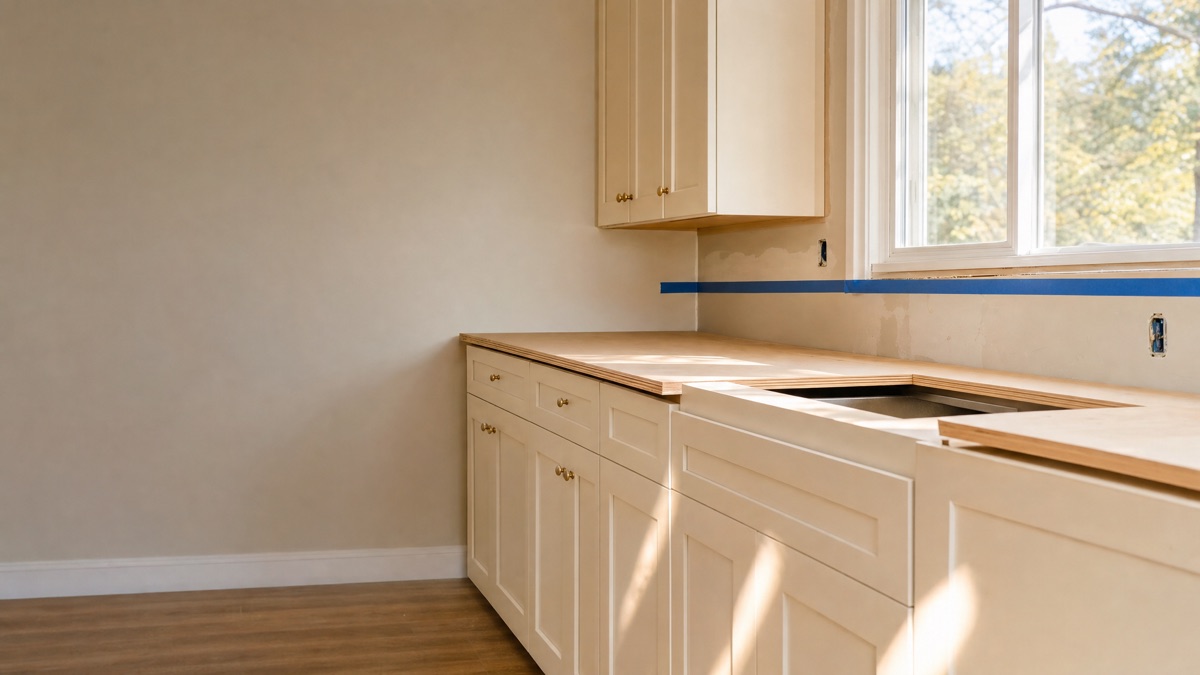
If you are pricing a whole kitchen rather than just the tops, countertops sit near the end of the build and their lead time drives the finish schedule more than any other material. Order cabinets, set them, template, then live with a plywood top for two weeks. The week-by-week kitchen timeline shows where that gap falls, and the tile calculator handles the backsplash that goes in right after.
Frequently Asked Questions
How do I calculate countertop square footage?
Measure each straight run in inches, length along the wall by depth front to back, multiply the two, and divide by 144 to get square feet. Add the island as its own rectangle. A typical 10x12 kitchen with two runs and a small island lands around 45-55 square feet, and fabricators bill from the templated area, not your tape measure.
How much does a quartz countertop cost per square foot in 2026?
Installed quartz runs $60-$150 per square foot in 2026, with most mid-grade jobs landing at $75-$110. That price includes the slab, fabrication, edge, cutouts, and installation. Entry-level box-store quartz can dip under $60 per square foot, while designer lines with heavy veining push past $150.
How many slabs do I need for my kitchen?
A standard quartz slab is about 55 by 120 inches, roughly 46 square feet gross and about 40 usable once you account for cut layout and 5-10% fabrication waste. Most kitchens under 40 square feet fit on one slab; over that, or with an island longer than about 110 inches, plan on two.
Is quartz or granite cheaper?
Granite is usually cheaper at the low end, starting near $50 per square foot installed versus $60 for quartz, because common granites are quarried in volume. At the mid and high end the two overlap almost completely. The real difference is upkeep: granite needs periodic sealing and quartz does not.
What does a countertop installer charge on top of the slab price?
Fabrication and installation typically run $25-$45 per square foot on top of material, and most quoted prices already fold it in. Add-ons are billed separately: $100-$300 per sink cutout, $10-$40 per linear foot for a premium edge, $200-$500 to tear out and haul away old tops, and $150-$400 for a plumber to reconnect the sink and disposal.
Getting New Countertops in Joliet or Will County?
Rehab Addicts templates, fabricates, and sets countertops as part of full kitchen remodeling projects across Joliet, Shorewood, and Will County, IL, including cabinet work, plumbing reconnect, and backsplash. Bring us your measurements and we will price the real thing. Free estimates.